
Affordable hardwood flooring is not a contradiction; it is a purchasing strategy. The same first-quality hardwood sold at a local showroom for a premium price is available at a significantly lower cost when you understand what actually drives the price and where the markup lives. The buyers who overpay for hardwood are not buying a better floor. They are paying for a showroom, a commissioned salesperson, and a regional distribution chain. This guide breaks down every decision point where you can reduce cost without reducing quality, from species and grade selection to construction format, finish type, and where you buy. For a full introduction to hardwood selection, the complete hardwood flooring guide at Flooring.org covers every variable in the buying process.
Seven Ways to Save on Hardwood Floors Without Buying an Inferior Product
1. Choose Engineered Over Solid for Most Applications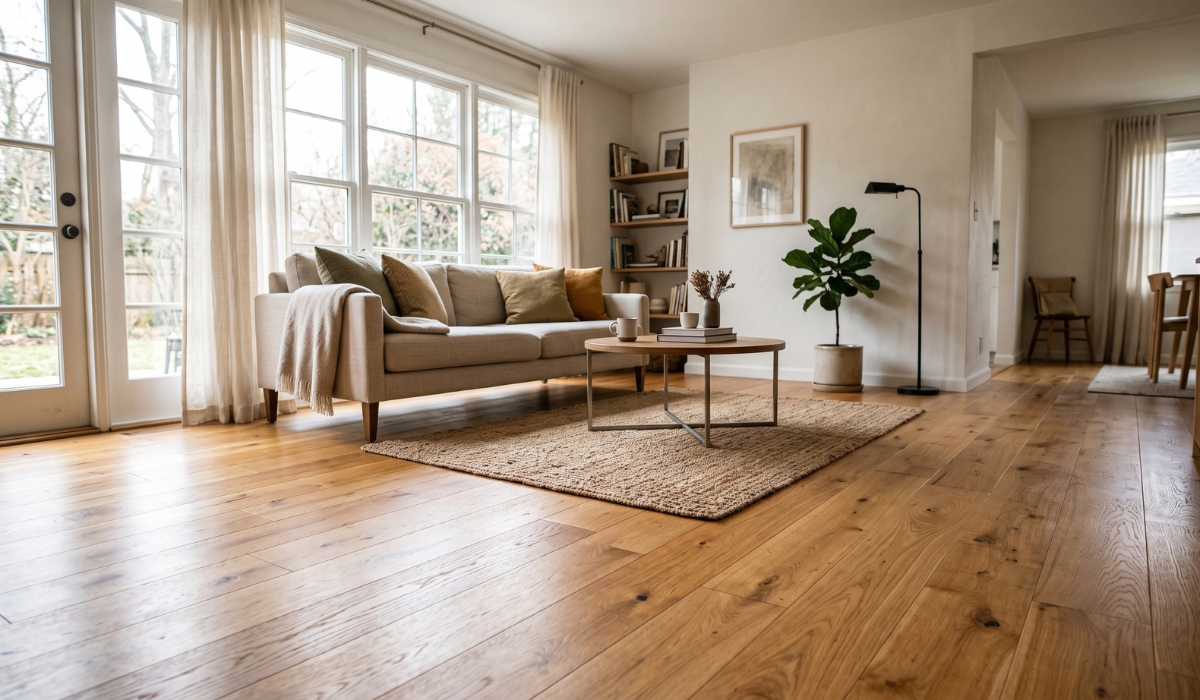
Engineered hardwood delivers a real wood surface, the same species, same grain, same finish as solid, at a lower material cost per square foot. The construction difference is in the core: a cross-ply plywood base rather than a single piece of milled lumber. That core is structurally smarter in most residential environments, not structurally inferior. Engineered hardwood handles humidity fluctuations better than solid, installs over concrete and radiant heat systems where solid cannot go, and is the more accessible DIY installation option through click-lock formats.
The savings are real. Entry-level engineered hardwood starts meaningfully below comparable solid hardwood in the same species. For buyers who want white oak, hickory, or walnut aesthetics without the solid hardwood price point, engineered is not a compromise. It is the correct product specification for most residential applications. The surface you walk on and look at every day is identical. Browse engineered hardwood specials at Flooring.org to see the current range of species and pricing.
2. Choose Standard Plank Widths Instead of Wide Plank
Wide plank hardwood, generally defined as planks 5 inches or wider, commands a 20 to 40 percent premium over standard-width boards in the same species and grade. That premium is real, and it is structural: wider boards require larger-diameter logs from older trees, which means lower yield per log and higher material cost per square foot.
Standard plank widths between 2-1/4 and 4 inches deliver the same species, the same finish, and the same performance at a significantly lower price. For buyers who love the wide plank aesthetic but are working with a tighter budget, a 4-inch board offers more visual presence than a 3-inch board without crossing into the wide plank premium territory. Alternatively, choosing wide plank in a character or rustic grade rather than select grade recovers some of the cost premium while preserving the dramatic visual impact that makes wide planks appealing in the first place.
3. Select Character Grade Instead of Select Grade
This is the most misunderstood money-saving decision available in hardwood flooring. Hardwood grades describe the appearance of the board face, specifically how much natural character, knots, mineral streaking, and color variation, is present. They have no bearing whatsoever on structural quality, hardness, or durability. A #1 Common or #2 Common white oak plank is just as hard, just as dense, and just as durable as a Select white oak plank from the same tree. The grade is a style specification, not a quality rating.
Character grades cost less because they use more of each log. Select grade requires the longest, clearest sections of lumber, which represents a smaller percentage of available yield. #1 Common and #2 Common grades draw from a larger portion of the log and are priced accordingly. For buyers who love a natural, rustic, or farmhouse aesthetic, which represents a significant and growing share of residential design preferences, a character grade floor is not the budget option. It is the intentional design choice that happens to cost less. The hardwood flooring grades guide explains every grade category in detail.
4. Choose Prefinished Over Site-Finished Hardwood
Unfinished hardwood that is sanded and finished on-site after installation adds labor cost to the total project that most buyers do not account for when comparing material prices. A professional sanding and finishing service typically adds between one and three dollars per square foot on top of standard installation labor. On a 1,000-square-foot project, that is a meaningful number.
Prefinished hardwood eliminates that cost. The factory-applied aluminum oxide finish arrives ready to install and ready to walk on the same day. It is also a harder finish than anything achievable on-site; UV-cured aluminum oxide rates between 9 and 9.5 on the Mohs hardness scale, outperforming site-applied polyurethane significantly in surface durability. Prefinished is not the cut-rate option. It is the more durable, more cost-effective, and more convenient option for the vast majority of residential projects. Flooring.org carries prefinished hardwood flooring starting at $2.99 per square foot with full manufacturer warranties.
5. Buy Online and Eliminate the Showroom Markup
A physical flooring showroom carries overhead that gets embedded in every price: retail floor space in a commercial location, in-store product displays, commissioned salespeople, and regional distribution chain costs. None of that overhead adds value to the floor you take home. It adds cost to the price you pay.
A direct-to-consumer online flooring retailer eliminates most of that overhead and passes the savings directly to the buyer. The product is identical, brand-new, first-quality hardwood in original manufacturer packaging with full manufacturer warranty. The business model is different. The floor is not. Flooring.org’s direct-to-consumer model consistently delivers pricing 20 to 40 percent below traditional retail and big-box stores on comparable first-quality products. On a 1,000-square-foot project, that difference can cover the cost of professional installation.
6. Choose Domestic Species Over Exotic
Domestic hardwood species- red oak, white oak, maple, hickory, ash- are more affordable than exotic species, not because they are inferior but because they are more widely available. A domestically grown and milled red oak floor carries a shorter supply chain, lower shipping costs, and higher production volume, all of which reduce the price without affecting the performance or durability of the finished product.
Red oak and white oak in particular represent the best value in the hardwood category by almost any measure. Both species are hard, durable, widely available in every grade and width, take stain well, and have been the standard for American hardwood floors for over a century. If a domestic species suits your aesthetic, choosing it over an exotic equivalent saves money without any performance trade-off. If an exotic look is the goal, engineered formats of exotic species, Brazilian cherry, tigerwood, and Santos mahogany deliver the same surface appearance at lower cost than solid exotic hardwood.
7. Shop Sales, Specials, and Clearance Inventory
First-quality hardwood flooring appears in sale and clearance inventory for reasons that have nothing to do with product quality: discontinued colorways, end-of-production-run lots, overstocked SKUs, and seasonal promotions. A floor in a clearance category is not a floor with a problem. It is a floor being moved at a lower price point because of an inventory circumstance, not a product defect.
The practical limitation of clearance inventory is quantity. If you find a product you love in a clearance or specials section, verify that the available quantity covers your project with the appropriate overage before ordering. Clearance lots are finite, and a reorder to match is often not possible. Order enough in one transaction and keep several boards for future repairs. Browse current flooring specials and sale inventory at Flooring.org to see what is available at promotional pricing today.
Frequently Asked Questions
What is the most affordable hardwood flooring option?
Entry-level engineered hardwood in a domestic species like red oak or ash, purchased in a character or #1 Common grade, from a direct-to-consumer online retailer rather than a showroom, gives you the lowest price per square foot on genuine hardwood without sacrificing durability or warranty coverage. Prefinished formats eliminate on-site finishing labor costs, reducing the total installed price further.
Is cheap hardwood flooring worth it?
The question conflates two different things: low price and low quality. First-quality hardwood purchased at a low price through a direct-to-consumer retailer is worth it. Second, clearance rejects, or products with no manufacturer warranty, are not. The distinction is not price, it is product specification and warranty coverage. Always confirm you are purchasing first-quality product with a manufacturer warranty, regardless of price.
Is engineered hardwood cheaper than solid?
Generally yes, with significant overlap in the mid-range. Entry-level engineered hardwood is typically less expensive than entry-level solid hardwood in the same species. Premium engineered hardwood with a thick veneer can approach or equal the price of mid-range solid. The total installed cost of engineered hardwood is often lower than solid when you factor in the elimination of finishing labor on prefinished products and the accessibility of DIY click-lock installation.
How do I get hardwood floors on a budget?
Apply multiple strategies simultaneously: choose engineered over solid, standard width over wide plank, character grade over select, prefinished over site-finished, domestic over exotic, and buy through a direct-to-consumer online retailer rather than a showroom. Each decision reduces cost independently. Combined, they can reduce the total material cost of a project by 40 to 60 percent compared to buying select-grade, wide-plank, solid, site-finished exotic hardwood at a showroom.
Does buying hardwood floors online actually save money?
Yes, consistently and significantly. Direct-to-consumer online flooring retailers eliminate showroom overhead and pass those savings to buyers. Flooring.org’s pricing runs 20 to 40 percent below traditional retail and big-box stores on comparable first-quality products. The floor is the same product. The price reflects a more efficient supply chain, not a lower-quality product.
Ready to find first-quality hardwood at prices that make sense? Browse current specials, explore the full product catalog, or revisit the complete buying guide to make sure every decision is working in your favor.
Read the Hardwood Flooring Guide
Shop Clearance and Deals
Shop Prefinished Hardwood