
Red oak hardwood flooring has held the top spot in American residential installations for more than a century, and that is not inertia. It is performance. At a Janka hardness rating of 1,290, red oak outperforms many species sold at a premium price point, absorbs stain evenly across its distinctive open grain, and comes from domestic forests that keep pricing accessible and supply consistent. If you are researching hardwood flooring for the first time, red oak is likely the standard everything else is being compared against. If you are coming back to it after considering other species, there is usually a reason. This guide covers what makes red oak the benchmark species, how it compares to white oak in practical terms, and what to know before buying it online. For a complete introduction to hardwood selection from species through installation, the complete hardwood flooring guide at Flooring.org covers every decision.
Why Red Oak Has Dominated American Hardwood Flooring for Decades
The dominance of red oak in American flooring is the result of several factors converging in a single species, none of which is coincidence or marketing.
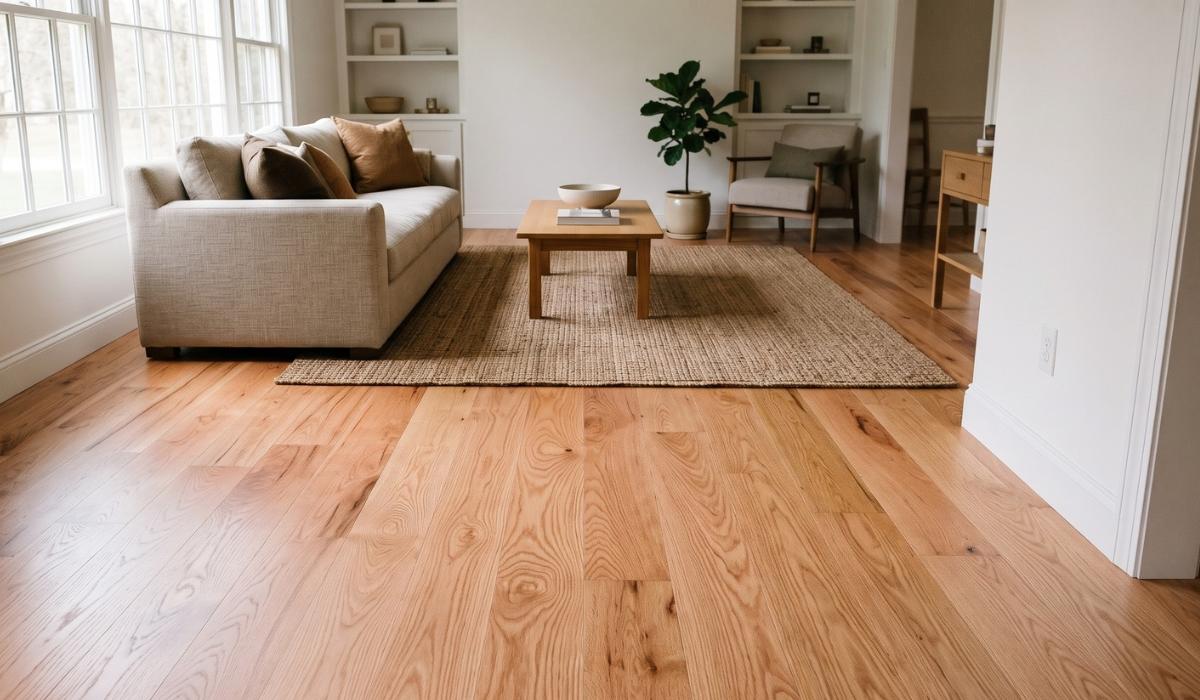
Hardness That Handles Real Life
At 1,290 on the Janka hardness scale, red oak is harder than walnut (1,010), harder than cherry (950), and harder than pine by a significant margin. It falls behind harder species like hickory (1,820) and Brazilian cherry (2,350), but it handles the demands of residential life, foot traffic, furniture, pets, and the occasional dropped kitchen item, without the finish wear and denting that softer domestic species show within a few years.
The practical implication of that hardness rating is a floor that refinishes well over decades. Red oak holds its surface long enough between refinishes to make the full lifecycle cost of solid red oak competitive with engineered products that cannot be refinished at all.
Open Grain That Accepts Stain Evenly
Red oak has a prominent, open grain structure with large pores that absorb stain deeply and evenly. This is the characteristic that makes red oak the most versatile species for custom color work. If you are choosing unfinished red oak to stain on-site, to match existing floors in adjacent rooms, to achieve a custom color, or to blend new flooring with original hardwood in an older home, red oak gives you the most reliable results across the widest range of stain colors.
Closed-grain species like maple resist stain absorption and produce blotchy results without careful preparation. Red oak does not have this problem. Dark stains, medium stains, gray tones, and natural finishes all absorb predictably into red oak’s open grain, which is a significant practical advantage for anyone doing custom color work.
Domestic Availability That Keeps Pricing Stable
Red oak is one of the most abundant hardwood species in North America. It grows throughout the eastern United States from Maine to Florida and west into the Great Plains, which means domestic sawmills have consistent supply and competitive pricing with no dependence on international sourcing. That supply stability keeps red oak pricing accessible relative to comparable hardwood species, and it means consistent availability across grades and dimensions without the lead times that affect exotic and imported species.
The result is a species where high-quality Select grade flooring is priced within reach of buyers who would otherwise be looking at engineered products, and where the per-square-foot cost of solid red oak compares favorably to many engineered alternatives at similar quality levels.
Red Oak vs. White Oak: The Real Differences
Red oak and white oak are the two most common hardwood flooring species in the United States, and the comparison between them is worth getting right. The differences are real but specific — understanding them helps you make a decision based on your actual project rather than general reputation.
Color Undertone
This is the most visible difference and the one that most often drives the decision. Red oak has a warm, pink-to-salmon undertone, particularly visible in natural and light stain finishes. The grain pattern is bold and prominent. White oak has a cooler gray-to-beige undertone with a tighter, more linear grain and distinctive ray-fleck pattern when rift or quarter sawn.
If your space has warm undertones, cream cabinetry, warm-toned walls, traditional or transitional furnishings, red oak integrates naturally. If your space leans cooler or more contemporary, white cabinetry, gray walls, Scandinavian or modern furnishings, white oak’s gray undertone tends to fit better without the need for a gray-toned stain to compensate. Neither is objectively better; the right choice is the one that works with what is already in the room.
For a full species comparison including Janka ratings, undertone characteristics, and best-use scenarios, see our guide to comparing red oak and white oak across the full species lineup.
Hardness
White oak is modestly harder at 1,360 Janka vs. red oak’s 1,290, a difference of roughly 5 percent that is unlikely to be noticeable in daily use. Both species handle residential traffic comfortably. The hardness gap becomes more relevant in high-traffic commercial applications, but for residential installation in living rooms, bedrooms, dining rooms, and kitchens, the difference between 1,290 and 1,360 is not a deciding factor.
Moisture Resistance
White oak has a tighter, closed grain structure that makes it more resistant to moisture absorption than red oak. This is the practical reason white oak is the traditional choice for wine barrels, boat building, and exterior applications. For interior flooring above grade, the difference is minor in most residential environments. Where it becomes relevant is in moisture-prone spaces, kitchens, mudrooms, and bathrooms, where white oak’s tighter grain provides a marginal advantage. That said, neither solid red oak nor solid white oak is appropriate for below-grade or over-slab installations regardless of grain structure; that application calls for engineered construction.
Price
Red oak is typically priced 10 to 20 percent below white oak at equivalent grades and dimensions, reflecting the greater abundance and domestic availability of red oak. The gap has narrowed as white oak’s design popularity has increased demand over the past decade, but red oak remains the more accessible option when budget is a consideration at comparable quality levels.
Which Room and Design Style Suits Each
- Red oak is the natural fit for traditional, transitional, colonial, craftsman, and farmhouse interiors with warm color palettes. It works across the full range of residential rooms and pairs particularly well with wood stains in the medium-to-warm range.
- White oak excels in contemporary, Scandinavian, mid-century modern, and coastal interiors where a cooler, more linear aesthetic is the goal. Its natural gray undertone works well with lighter finishes and pairs cleanly with white and gray cabinetry.
How to Buy Red Oak Hardwood Flooring Online
Red oak is available in a wider range of grades, widths, thicknesses, and finish options than almost any other species, which is an advantage for buyers who know what to look for and a potential source of confusion for those who do not. Here is what to confirm before placing your order.
Grade Selection
Hardwood flooring grade describes the appearance of the wood, the amount of natural character, color variation, and mineral streaking in the boards, not the structural quality. All grades of red oak are equally strong and durable. The grade you choose is an aesthetic and budget decision.
- Select and Better (sometimes listed as Select or Clear) is the most uniform grade. Boards are largely free of knots, with consistent color and minimal mineral streaking. This is the grade that photographs most cleanly in showrooms and is the typical choice for formal spaces where a uniform appearance is the goal.
- #1 Common includes more natural character, some mineral streaking, slight color variation between boards, and occasional small knots. The result is a floor with more visual interest and a more natural appearance. Many buyers prefer #1 Common specifically for its character. It is also typically priced 15 to 25 percent below Select grade.
- #2 Common (also called Character grade by some retailers) includes the full range of natural wood character, prominent knots, significant color variation, and mineral streaking. It produces a highly rustic, characterful floor and is the most budget-accessible grade of red oak.
For a full explanation of NWFA grading standards and how grade affects appearance across species, see our guide to Select and #1 Common grade red oak and what each grade looks like in a finished installation.
Width: Standard vs. Wide Plank
Red oak is available in standard strip widths (2.25 inch and 3.25 inch) and in wider plank formats (4 inch through 7 inch and beyond). Narrower strips are traditional and work well in smaller rooms, hallways, and spaces where you want the floor to feel classic. Wider planks show more of the grain pattern per board, make smaller rooms feel larger, and suit the contemporary and farmhouse design styles that have driven demand for wide plank flooring over the past decade.
One practical consideration with wide plank solid red oak: wider boards move more with seasonal humidity changes than narrower strips do. In climates with significant seasonal humidity swings, wider solid planks require careful acclimation and stable in-home humidity to perform well. Engineered red oak in wide plank widths is dimensionally more stable and is worth considering for environments with less controlled humidity.
Prefinished vs. Unfinished
Prefinished red oak arrives with a factory-applied aluminum oxide finish, typically 7 to 9 coats UV-cured to a hardness that exceeds anything achievable with on-site polyurethane. It installs and is walkable immediately with no cure time, no finishing odor, and no waiting. This is the right choice for most buyers who want a known, durable result with the fastest path from delivery to finished floor.
Unfinished red oak is the right choice when you need to match an existing floor in an adjacent room, achieve a custom stain color, or sand and finish new and existing flooring together as a seamless installation. The open grain of red oak makes it the most stain-receptive domestic species, which is precisely why unfinished red oak remains the standard choice for custom-color and restoration work.
Where to Find Red Oak at Flooring.org
Flooring.org carries red oak in solid and engineered construction, prefinished and unfinished, across a range of grades and widths from established domestic manufacturers. Browse the full selection of hardwood flooring brands available at Flooring.org to compare red oak options across manufacturers, or use the site’s species and grade filters to narrow by the specifications that fit your project.
Frequently Asked Questions
How much does red oak hardwood flooring cost?
Red oak flooring typically runs $3 to $7 per square foot for the material, depending on grade, width, and whether it is prefinished or unfinished. Select grade prefinished red oak at standard widths falls toward the middle of that range. #1 Common and #2 Common grades cost less; wide plank and specialty cuts cost more. Installation labor adds $3 to $8 per square foot depending on method and market. Buying direct from an online retailer like Flooring.org typically saves 20 to 40 percent compared to local showroom pricing on the same products.
Is red oak or white oak better for flooring?
Neither is objectively better, the right choice depends on your design style, existing finishes, and budget. Red oak has a warm pink undertone and bold open grain that suits traditional and transitional interiors. White oak has a cooler gray undertone and tighter grain that suits contemporary and Scandinavian design. White oak is modestly harder (1,360 vs. 1,290 Janka) and slightly more moisture resistant, but the practical difference in residential use is minimal. Red oak is typically 10 to 20 percent less expensive at equivalent grades.
Can red oak hardwood flooring be refinished?
Yes. Solid red oak at standard 3/4-inch thickness can be sanded and refinished 7 to 10 times over its lifetime, depending on how much material is removed each time. This is one of the primary advantages of solid hardwood over engineered products with thin veneers that allow only one or two refinishes. Prefinished red oak can be refinished after the factory finish wears through; unfinished site-finished red oak follows the same schedule based on the thickness of the on-site finish coats applied.
What stain colors work best on red oak?
Red oak accepts the full range of stain colors, but its pink undertone interacts with certain shades in ways worth understanding before choosing. Natural and light stains emphasize the warm pink tone, which is desirable in traditional interiors and unwanted in contemporary ones. Medium browns and warm tones complement red oak’s natural color. Gray stains can be applied to red oak but require careful testing, the pink undertone can produce a muddy result with some gray tones. If a cool gray finish is the goal, white oak’s naturally cooler undertone typically produces cleaner results without a compensating stain formula.
What is the Janka hardness of red oak?
Red oak has a Janka hardness rating of 1,290, which places it solidly in the mid-range of domestic hardwood species. It is harder than walnut (1,010), cherry (950), and all domestic pine species, and softer than hickory (1,820), white ash (1,320), and white oak (1,360). The 1,290 rating means red oak handles the demands of residential living well with appropriate finish maintenance, without the installation challenges of extremely hard species that blunt cutting tools and require more precise technique.
Ready to explore red oak flooring for your project? Browse Flooring.org’s full selection at wholesale pricing or read the complete hardwood guide to compare species, grades, and construction before you order.